Education Uninterrupted

A second chance at an education.

Supporting Adolescent Girls’ Education. A community-based model for girls who are out of school, married, or already mothers, built on the understanding that one rigid route back into learning will not reach them.

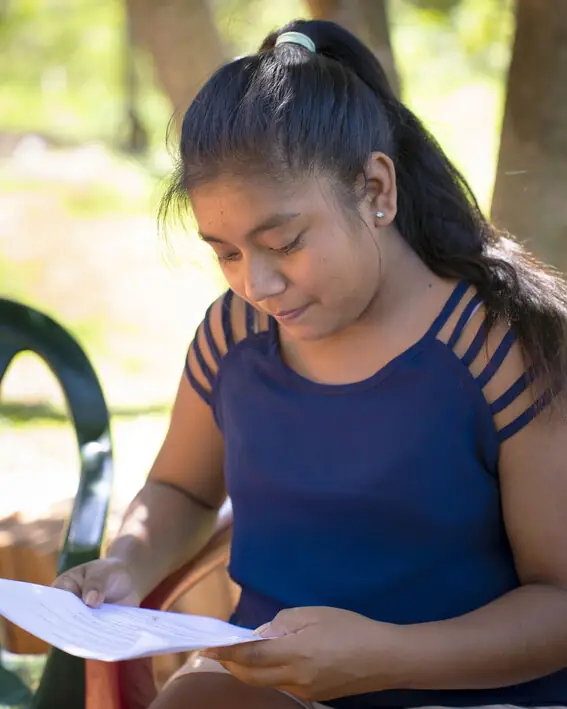
A teenage girl seated outdoors on a plastic chair, reading a printed handout.

Paraguay. © Plan International

What it is

Education that goes to the girls school has stopped reaching.

The objective

Four routes, not one

A gender-transformative, community-based education programme combining accelerated literacy and numeracy, life-skills and health education, and vocational training, to help marginalised out-of-school girls and adolescent young women aged 10 to 19 re-engage with learning and transition into further education or livelihoods.

  • Re-entry into formal school
  • Informal or community-based learning
  • Skills training for self-employment
  • Fairly paid employment
Where it has run

Zimbabwe, and next

Piloted in Zimbabwe across 88 community hubs. Over the whole project, SAGE reached 20,525 participants: 13,450 girls and adolescent young women in Phase 1, and 7,075 in Phase 2 (5,657 girls and 1,418 boys). The programme also reached 77,300 indirect participants. Source: Plan International, Value for Money Brief: Supporting Adolescent Girls’ Education (SAGE) in Zimbabwe (internal, not published), via the Global Girls Foundation, 5 October 2026. The model is ready to scale in countries including Laos, Nigeria and Ghana, with continued support in Zimbabwe. Source: Global Girls Foundation, 5 October 2026, from Plan International’s Education Lead at its Global Hub.

What it has already done

Results from the Zimbabwe programme.

Closing the learning gap
Over 75% of participants improved their foundational literacy and numeracy.

Source: Plan International, SAGE – Supporting Adolescent Girls’ Education (November 2025), p2.

Skills and financial independence
52.7% of learners enrolled in the Integrated Skills Outreach Programme and vocational training.

Source: Plan International, SAGE – Supporting Adolescent Girls’ Education (November 2025), p3.

Economic empowerment
900 girls opened bank accounts.

Source: Plan International, SAGE – Supporting Adolescent Girls’ Education (November 2025), p3.

A second chance
Married girls and young mothers are nearly 45% of SAGE’s learners, and many described it as a second chance.

Source: Plan International, SAGE – Supporting Adolescent Girls’ Education (November 2025), p3.

Social norms
Caregivers holding positive views on gender rose from 25% to 72%.

Source: Global Girls Foundation, supplied 30 September 2026.

Systems change
Government adoption of the learning material and the protection systems, and strengthened teacher training.

Source: Global Girls Foundation, supplied 30 September 2026.

Recognition
In 2025, SAGE won International Collaboration of the Year at the Times Higher Education Awards. The Open University, a partner alongside Plan International Zimbabwe, collected the award.

Source: Times Higher Education, “Times Higher Education Awards 2025: winners announced”, 13 November 2025; Plan International, Education Uninterrupted flagship presentation (May 2026), slide 8.

What it is built to change

Projected outcomes.

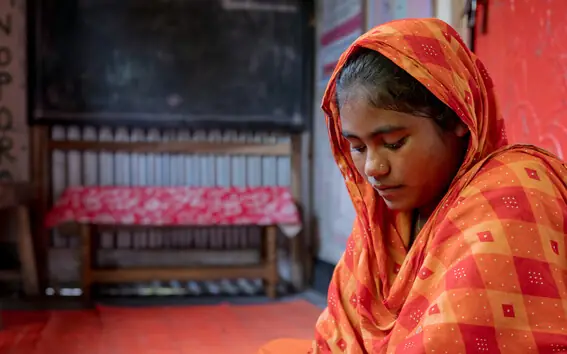
A teenage girl in an orange headscarf looks down at her work in a learning centre, a blackboard behind her.

Bangladesh. © Plan International

Who it reaches

Married girls, young mothers, girls who have never been to school, girls with disabilities, girls from ethnic minorities, and girls engaged in labour.

What changes

Increased access to employment. Community Educators who challenge the assumption that boys perform better than girls. A shift in how girls see male-dominated work, and the confidence to go into it.

What follows

Fewer child, early and forced marriages. Fewer teenage pregnancies. Lower maternal mortality.

What it costs

Investing in out-⁠of-⁠school girls.

Investing in adolescent girls’ education is one of the most effective ways to break cycles of poverty and inequality. Educated girls are more likely to earn higher incomes, make informed health decisions, delay early marriage and pregnancy, and become leaders in their communities. Donor investments transform individual lives and generate long-term social and economic returns for communities and nations.

Investment
€500,000 per year, per country. €2.5 million for a five-year implementation plan in one country.

Source: Global Girls Foundation, supplied 30 September 2026.

Reach
3,500+ girls per year, depending on context.

Source: Global Girls Foundation, supplied 30 September 2026.